California JADU and Owner Occupancy: What AB 1154 Means for Renters
Chris Koss, AIA|Published June 7, 2026|Last updated June 10, 2026
AB 1154, signed October 2025, limits JADU owner-occupancy rules to units sharing a bathroom with the main house, and requires all JADU leases run longer than 30 days statewide. Here's what renters need to know.
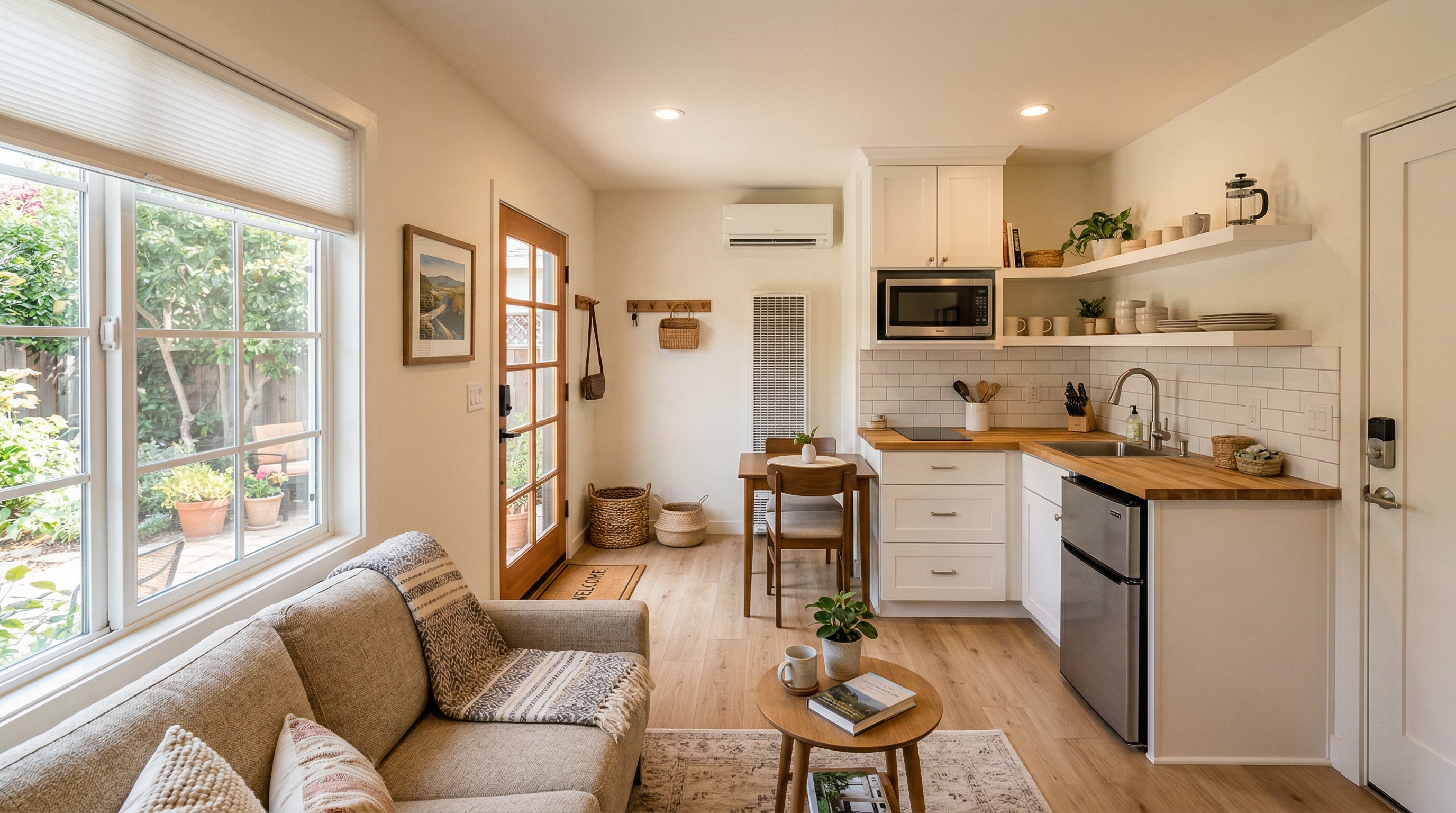
Image from GatherADU's April 2026 guide to AB 1154 and JADU owner-occupancy in California. GatherADU.
As of January 1, 2026, California law limits when a city can require a property owner to live on-site as a condition of renting out a junior accessory dwelling unit. The change comes from AB 1154, signed by Governor Newsom on October 10, 2025, which amends Government Code Section 66333. The short version: if a JADU has its own bathroom, local agencies can no longer impose an owner-occupancy condition. If it shares a bathroom with the main house, they still can. And every JADU rental in the state now carries a 30-day minimum lease floor.
What the bill actually changed
Before AB 1154, any city ordinance that allowed JADU creation had to require owner-occupancy. The property owner had to live in the single-family residence, or in the JADU itself. That was the statewide default for any local program creating JADUs.
The amended Government Code Section 66333(b) now reads: "If the junior accessory dwelling unit has shared sanitation facilities with the existing structure, require owner-occupancy in the single-family residence in which the junior accessory dwelling unit will be permitted." And then: "Owner-occupancy shall not be required if the junior accessory dwelling unit has separate sanitation facilities."
One bathroom is now the dividing line. A JADU with its own toilet, sink, and shower is exempt from any owner-occupancy condition under state law. A JADU that uses the main house bathroom can still have one, if the city has adopted an ordinance imposing it. The bill also carves out JADUs owned by governmental agencies, land trusts, or housing organizations from the requirement regardless of bathroom configuration. AB 1154 was authored by Assemblymember Carrillo and signed as Chapter 507 of the Statutes of 2025.
Why this matters if you are a JADU tenant
If you are renting a JADU in California, or evaluating one, the bathroom configuration of the unit now has a direct bearing on your lease security.
Under the old framework, your tenancy was implicitly tied to the owner's continued presence on the property. If the owner moved out, they were technically in violation of city code (where such ordinances existed). What happened in practice varied by city and landlord, but it created real uncertainty: a tenant in a shared-bathroom JADU was, in some cities, renting in a unit that legally required the owner to remain on-site.
Under AB 1154, if your JADU has a private bathroom, that link is severed. The owner can move to another city, rent out the main house, or relocate without putting the JADU tenancy at risk from a city-compliance standpoint. Your lease does not depend on where the owner lives.
If your JADU shares a bathroom with the primary dwelling (which is common in converted bedrooms, bonus rooms, or garage spaces where the bathroom is accessed through the main house), the rule may still apply in cities that have adopted an owner-occupancy ordinance for shared-bathroom JADUs. The bill authorizes cities to impose the condition in those cases; it does not require them to. The outcome depends on the specific city ordinance.
Standard ADUs are different. AB 976, which became permanent law in 2024, eliminated owner-occupancy requirements for standard ADUs entirely. An owner can rent out both the primary house and a detached or attached ADU without living on the property. AB 1154 moves JADUs closer to that model, with the shared-bathroom exception still in play for cities that choose to use it.
The 30-day floor on all JADU rentals
Separate from the owner-occupancy change, AB 1154 added a new universal rule to Government Code 66333(g): any rental of a JADU must be for a term longer than 30 days. This is statewide, mandatory, and applies regardless of whether the JADU has a shared or private bathroom.
This closes the short-term rental door on JADUs in California. A JADU cannot be listed on Airbnb, VRBO, or similar platforms for stays under 30 days. A month-to-month tenancy is fine; a 14-day vacation rental is not. The 30-day floor applies even in cities that might otherwise allow short-term rentals of other property types.
If you are a prospective JADU tenant, this rule works in your favor: it means the unit you are evaluating cannot legally double as a short-term rental. The owner is required by state law to offer it on a residential, longer-term basis.
If you are a homeowner who has been renting a JADU short-term, AB 1154 closed that path as of January 1, 2026. This applies independent of what your city ordinance says about short-term rentals of other unit types.
What to ask before you sign a JADU lease
If you are a tenant evaluating a JADU in California today, here are the practical questions that follow directly from AB 1154:
Does this unit have its own bathroom? A JADU with a private bathroom is not subject to owner-occupancy conditions under state law, regardless of what city you are in. A shared-bathroom JADU may still be subject to one if the city has adopted an ordinance using the authority AB 1154 preserved. Ask the landlord directly, and request a copy of the building permit or city records showing the approved bathroom configuration.
Has your city adopted an owner-occupancy ordinance for shared-bathroom JADUs? Not every city has. Look up the city building and safety department ADU ordinance page. Los Angeles, San Diego, San Jose, Oakland, and Sacramento all publish their ADU ordinances online. If the JADU you are evaluating shares sanitation facilities, this is the document that tells you whether an owner-occupancy condition is active.
Is the lease term longer than 30 days? Under AB 1154 it must be. Any lease shorter than 30 days on a JADU violates state law. Month-to-month is fine; anything shorter is not, regardless of what any listing platform or landlord claims.
Is the unit permitted as a JADU? A legal JADU has a recorded deed restriction showing the unit classification and the restrictions on sale and use. Ask for the permit history at the city building department if the landlord cannot produce documentation. Unpermitted units do not carry the same legal protections under the ADU statutes.
If you are searching for permitted JADU and ADU rentals in California, A-du's rental map shows listings where owners have verified permits, so you start from a known-compliant baseline before you set up a tour.