HELOC vs. Construction Loan vs. Cash-Out Refi for Your California ADU
Chris Koss, AIA|Published June 13, 2026
California homeowners financing an ADU build in 2026 have three main options: HELOC, cash-out refi, or construction loan. Rates run 6.25 to 9 percent. Here is the decision tree to find the right fit.
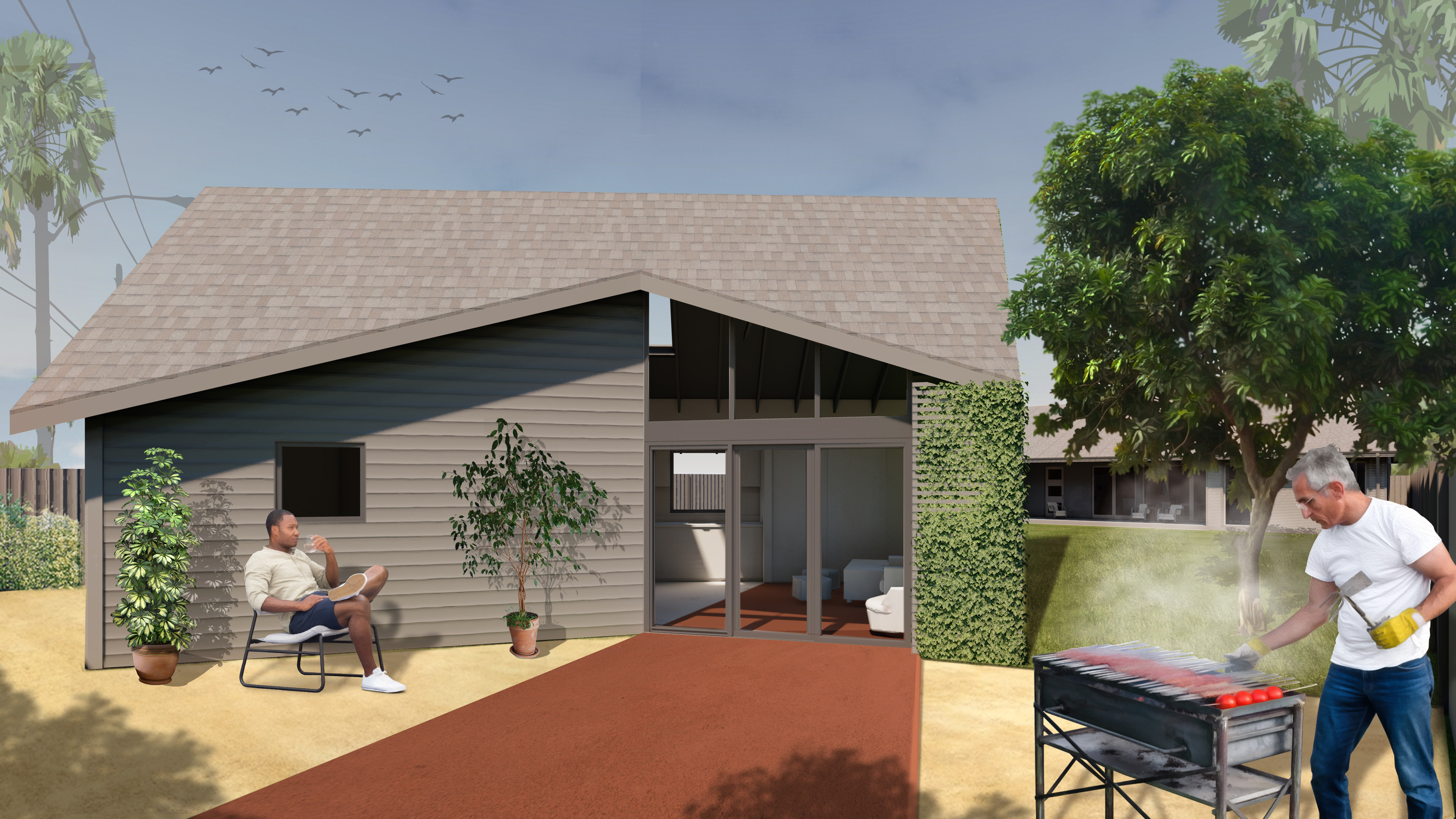
The YOU-ADU, a free city-provided 455-square-foot plan from the Los Angeles Department of Building and Safety, in a charcoal-siding configuration. What you build and how you pay for it are two different conversations.
The CalHFA ADU Grant has been paused since April 2026, with no confirmed relaunch date. For most California homeowners, that means financing an ADU build without a $40,000 head start on soft costs. Three tools cover nearly every realistic scenario: a home equity line of credit (HELOC), a cash-out refinance, and a construction loan. Rates today range from roughly 6.25 percent to 9 percent depending on the product and your credit profile. The right choice is almost never about which rate looks lowest on a comparison chart. It is about which loan fits what you already own.
What each product actually is
A HELOC is a revolving line of credit secured against the equity in your home. You draw from it in stages as you pay contractors, pay interest only on what you have drawn, and the rate floats with the prime rate, which sat at 6.75 percent in June 2026. California credit unions are advertising HELOC rates from 6.5 to 7 percent for well-qualified borrowers; conventional banks are running 7 to 8 percent. The critical advantage: you keep your existing first mortgage intact. If you locked a 3 or 4 percent rate between 2020 and 2022, a HELOC lets you borrow against equity without touching that loan at all.
A cash-out refinance replaces your first mortgage entirely. You refinance into a larger loan, receive the difference as a lump sum, and use it to build. Cash-out refi rates in California are running 6.25 to 7 percent on a 30-year fixed as of early 2026. The math favors a cash-out when your existing mortgage rate is already above 6.5 percent, or when you want a single predictable fixed payment rather than a separate line you need to manage through construction.
A construction loan is a short-term product, typically 12 to 18 months, that funds staged draws as work progresses. It then converts to permanent financing when the ADU is complete. Construction loan rates in California are running 7 to 9 percent in 2026, according to lender surveys. They are more expensive than the other two options, but they serve two scenarios nothing else covers cleanly: homeowners with significant equity who do not want to refinance their first mortgage under any conditions, and projects where the lender-managed draw schedule adds genuine discipline to an owner-builder situation.

The decision tree
Start with your current mortgage rate. That one number resolves most of the decision.
If your rate is below 5.5 percent, a HELOC is the default choice for most ADU projects. You keep the low-rate first mortgage, draw funds as construction milestones land, and pay variable interest only on what you have spent. The risk is rate movement: if prime rises, your HELOC payment rises with it. For a $120,000 JADU conversion, that exposure is manageable. For a $280,000 detached ADU, model two or three rate scenarios before committing.
If your rate is already above 6.5 percent, a cash-out refinance often costs you nothing extra in effective rate while giving you a lump sum at closing. You refinance at a rate close to what you are currently paying, add the construction funds, and end up with one mortgage payment instead of two. If you retain at least 20 percent equity after the cash-out, this is frequently the simplest path for a new detached ADU in the $200,000 to $350,000 range.
If you hold less than 20 percent equity, neither a HELOC nor a cash-out refi is likely to qualify. A construction loan becomes the fallback, with higher rates. An FHA 203(k) loan, which permits construction on a primary residence with as little as 3.5 percent down, is another option for owner-occupants, though it carries mortgage insurance premiums and stricter contractor documentation requirements.
If the ADU is a rental investment rather than family housing, DSCR loans (debt-service coverage ratio products) are worth asking California portfolio lenders about. DSCR products qualify you on projected rental income rather than personal W-2 income, which matters for homeowners whose earned income would not otherwise support the loan amount. Expect rates of 7.5 to 9 percent in the current environment.
What the math looks like in practice
Say you are a homeowner in Glendale. Your property appraised at $950,000 in 2025. You carry a $420,000 mortgage at 4.1 percent. You want to build a 640-square-foot detached ADU for $235,000 all-in, including design fees, permits, and construction.
Your equity is $530,000. A HELOC at 80 percent combined loan-to-value gives you a line of up to $340,000 (0.8 times $950,000, minus the existing $420,000 balance). More than enough. You draw $235,000 as work progresses, pay roughly $1,275 per month in interest during the build at a 6.5 percent rate, and once the ADU certificate of occupancy is issued, begin collecting rent. At that point, many owners refinance the HELOC balance into a fixed-rate second mortgage or pay it down from rental income.
Change one number: your existing mortgage is at 6.8 percent instead of 4.1 percent. Refinancing the entire balance at 6.6 percent on a new $655,000 loan produces a monthly payment of roughly $4,200 on a 30-year fixed. You have freed up the same $235,000 for construction, improved your rate marginally, and carry one loan instead of two. Total cost of capital is similar to the HELOC path, but without variable-rate exposure going forward.

The CalHFA pause and what to track
The CalHFA ADU Grant Program covered up to $40,000 in pre-development costs: architectural fees, permit applications, soil tests, and impact fees. It has been paused since April 2026 with no confirmed relaunch date. Without it, those soft costs land directly on the homeowner before construction financing even becomes relevant. Per the California Department of Housing and Community Development, ADU construction activity is growing steadily across the state; in high-cost cities like Los Angeles and San Jose, pre-development soft costs for a detached unit routinely run $20,000 to $40,000 before a single foundation is poured. Budget for that line before you price a loan.
Watch the CalHFA program page for relaunch announcements. When the grant returns, it covers only pre-development costs, not construction; the financing decision above applies in full regardless. If you are a first-time ADU client still mapping your project budget, A-du's permit fee calculator gives you a city-by-city breakdown of what permit and impact fees will run before you commit to a financing structure.