Building A-du · Part Nine: A-du Manage
Building A-du: Part Nine
Chris Koss, AIA|Published May 22, 2026|Last updated May 29, 2026
Eleven service categories, a Google-Places-fed seed, and a claim flow that pays the actual local business. How A-du Manage's services marketplace got built, claim flow first, lead flow second.
The problem
An ADU eventually needs a lot of services around it. Cleaning between tenants. Handyman work. Landscaping. Moving help. Pest control. Pool service if there's a pool. The kind of things that, in aggregate, are the difference between a landlord enjoying their ADU as an additional source of income and a landlord regretting the day they ever decided to rent it out.
Most of those services are run by small local businesses (genuinely small, often family-run) that don't have a strong online presence, don't run a national marketing budget, and don't necessarily show up first in a search even when they're the right answer. A landlord who needs a turnover cleaner ends up either calling someone they once met at a barbecue or picking the first Yelp result, and neither of those is a great process.
I wanted A-du Manage to make this part of the work simple. Not by inventing a new directory of services, but by surfacing the businesses that already exist, in a way that lets the local business and the landlord both win.
The part that took the most thought wasn't the surfacing. It was the question of how a small local business actually gets on board with a platform like A-du. That problem has a specific answer, and it shapes how we built the rest.
What we built
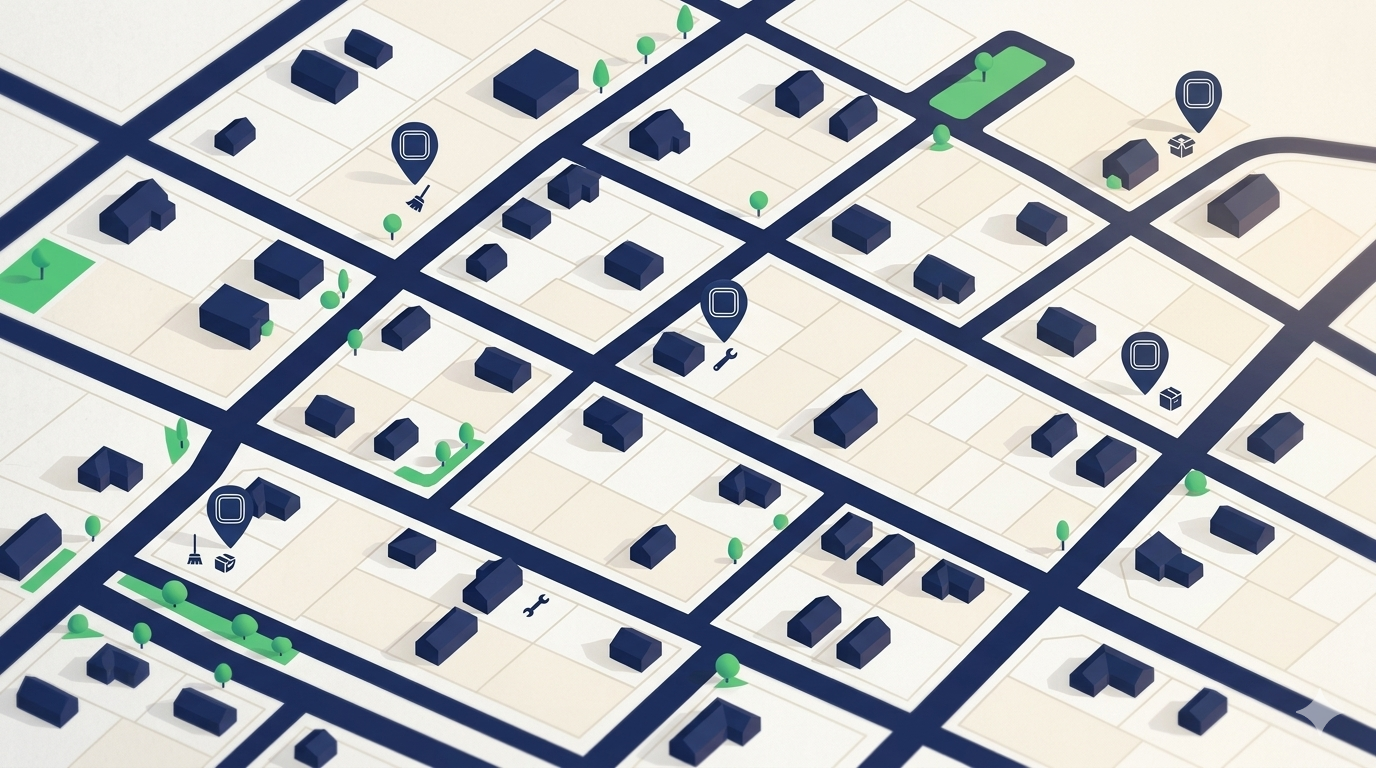
A-du Manage's services marketplace currently spans eleven categories, the ones a landlord or tenant on the platform is likely to need. That includes cleaning, handyman, landscaping, pest control, moving, and the rest of what you'd expect.
Each category was seeded by carefully querying Google Places for legitimate, listed local businesses in the LA County area, with the kind of contact information and operating hours you'd expect a real business to have. We then enriched each listing with whatever public-record information was available: the business's website if they had one, a description if Google had a useful one, and so on.
That gives us a marketplace that, on day one, has actual businesses in it. Not stubs, not stock-photo placeholders. Real, operating local businesses with real addresses.
But none of those businesses agreed to be in our marketplace. They have an existence on Google. We surfaced that existence on A-du. That isn't enough on its own. You can't run a transactional marketplace on top of businesses that don't know they're in it.
So we built the claim flow first.
When a service business owner finds their business in A-du Manage's marketplace, they can claim it. That's a real flow: they verify they own the business (typically with a phone or mail verification, in a way that shouldn't surprise anyone familiar with how Google My Business works), they go through identity verification through Stripe, they connect a Stripe account so payments can flow to them, and they take ownership of the listing. From that point forward, the listing is theirs. They can edit it. They can adjust their service area. They can update their hours. The lead flow runs to them. The platform takes a small platform fee on transactions (clearly disclosed, the same fee for every business) and the rest of the money goes to the actual business.
If a business owner doesn't want to be on A-du, the same flow gives them a removal path. They can request that their listing be taken down, with a verification step to make sure the request is from the business itself. We built the takedown path at the same time as the claim path, deliberately. The right time to design "I want off this platform" is before anyone's complained.
A few additional design notes worth surfacing:
- Every service listing is honest about its source. If a listing was seeded from public-record data and not yet claimed, it says so. There's no implication that the business signed up to be there.
- Categories are persona-aware. A landlord browsing the marketplace sees the categories most relevant to running a rental. A tenant browsing sees the categories most relevant to moving in or living in an ADU. The data is the same; the surfacing is tuned.
- The platform fee is enforced consistently. The 8% fee we charge on services bookings is set in one place (a platform-settings record) and read everywhere else. There's no fee that some businesses pay and others don't. Same rules for everyone.
What it means for you
If you run a local service business that works with rental properties (cleaning, handyman, landscaping, pest control, moving, the rest), A-du Manage probably has a stub listing for you. You can claim it, take ownership, set up payments, and start receiving leads from real landlords and tenants who need your work. The signup is free. You only pay a fee when you actually do work that's booked through the platform.
If you're a landlord on A-du, you can find local services attached to your property in one place, with consistent information, transparent pricing, and a payment flow that keeps the receipts in one workflow.
If you're a tenant, the same. When you need help during your tenancy, you can find vetted local services from inside your A-du dashboard rather than starting from a cold search.
What I learned
The first lesson is the marketplace lesson I keep coming back to: build the claim flow before you build the lead flow. The temptation, when you're standing up a services marketplace, is to focus on the demand side (landlords and tenants) and treat the supply side as something that'll happen later. That ordering produces a marketplace where the demand side has a nice product, the supply side feels surprised, and the transactions don't actually run cleanly because the businesses on the receiving end haven't onboarded.
We did it the other way. The claim flow, the verification, the Stripe Connect onboarding, the takedown path: those came first, before we drove demand to the marketplace. That meant the first time a real local business owner found out they were on A-du, the experience was: "Oh, I can claim this, and here's how the payment side works." Not: "There's a stranger asking me to come do work, but I don't know who's going to pay me."
The second lesson is about respect. Surfacing public-record information is fine. Pretending that a business signed up to be in your marketplace when they didn't is not fine. The honest labelling on unclaimed listings ("this listing was seeded from public information; the business has not yet joined") is what lets the marketplace be both useful on day one and respectful of the businesses we're hoping will eventually join.
The third lesson is about scope. We could have launched the services marketplace with thirty categories. We launched with eleven. The eleven were the categories that an actual landlord or tenant on A-du was actually likely to need. The other nineteen would have been padding. A marketplace with eleven solid categories is a better marketplace than one with thirty half-stocked ones.
Next in the series: the same idea, applied to property managers. How A-du Manage onboards local management companies. Claim, verify, and become an A-du Manage partner.