Building A-du · Prelude
Building A-du: Prelude
Chris Koss, AIA|Published May 2, 2026|Last updated May 29, 2026
How I came to ADUs, and what it actually took to turn the conviction into a working platform. An architect's path from the Midwest to LA, and the iterative work behind A-du Rent, Build, and Manage.
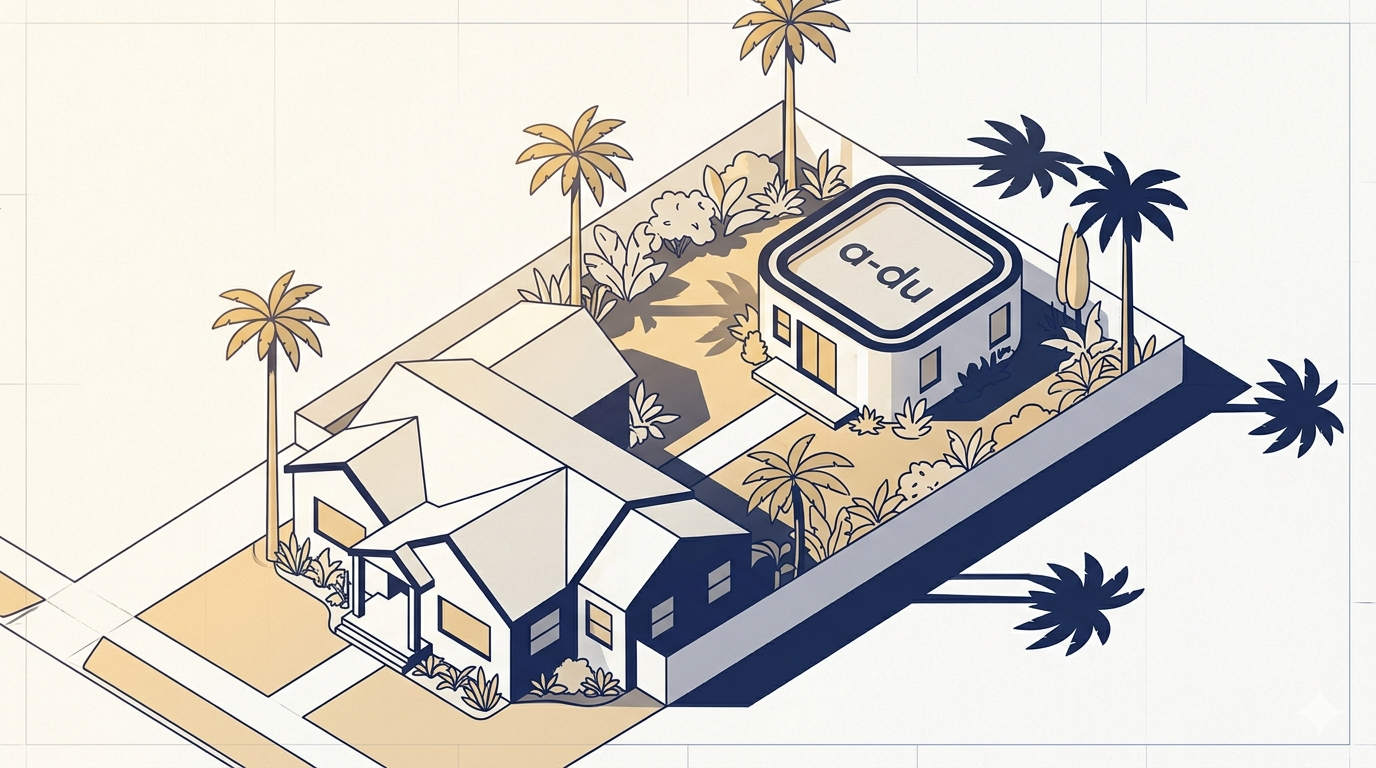
I'm Chris Koss. I'm a California-licensed architect, and I run A-du.
When I moved to downtown LA from the Midwest, I didn't even know an ADU was an option, let alone what one was. I came to work for Perkins&Will's downtown office designing healthcare projects like hospitals, MOBs, and clinics, so I was seldom exposed to local residential design nuances and trends. It wasn't until 2020 that I discovered the then-relatively-new ADU typology, and the contrast struck me: I had come from a place where space is abundant to a city where virtually every lot is developed and single-family residential lots seem to dominate.
To me, LA has always felt like a collection of urban centers surrounded by a sea of single-family residences. This is no accident. LA was zoned for roughly 10 million people in 1960, then systematically downzoned through the 60s, 70s, and 80s (Prop U in 1986 being a major example) under pressure from homeowner groups. Today, Angelenos face a housing crisis like no other, the product of decades of restrictive zoning that intentionally limited population growth. Some multi-family developers do undertake the arduous process of rezoning single-family lots to add housing stock, but these efforts often fail or are accused of undermining the character of otherwise single-family neighborhoods.
ADUs are an unusual policy lever. They take the people who already live in a neighborhood, often people who have been there for decades, and make them participants in expanding the housing supply instead of bystanders or opponents of it. They densify thoughtfully. They activate underused lots. They keep families and caregivers and adult children near each other when the alternative is leaving. They let renters live in genuinely good neighborhoods at prices that aren't possible in a new tower. As an architect I care about the built environment, and I care about proximity. I care about people staying close to the cultural, food, and social infrastructure they came for. ADUs do both.
In 2016, amid the state's unfolding housing crisis, California further paved the way for homeowners to build accessory dwelling units on their own property. The initial ADU framework was passed in 1982, but the Big Shift came in 2016 and 2017, when major legislation (SB 1069, AB 2299, and AB 2406) imposed a legal floor on local ordinances and removed strict restrictions on parking, fees, and permitting. The result has been a massive increase in development. Each year since has brought new efforts to ease restrictions on owner-occupancy requirements, lot sizes, and HOA rules.
Given all the continuous, top-down regulatory support for ADUs in California, I was surprised to find very little bottom-up support for the individual homeowners who actually set out to build one. Getting from concept to certificate of occupancy remains a fragmented process, full of invisible pitfalls, obstacles, and delays that discourage first-time ADU builders.
This gap is what inspired A-du. Whether a homeowner is contemplating a detached ADU, working with unpermitted or permitted plans, soliciting contractor bids, or looking to rent out a finished unit, A-du has the tools to support them at every step.
A-du has three components. A-du Rent is the rental marketplace. It's the part of the platform that takes a landlord from "I have a finished ADU" through verifying their identity, screening a tenant fairly, generating and signing the lease, adding any addendums, and collecting rent each month. It also has an outreach side: when LA County publishes a completed ADU permit, we surface it as a draft listing and mail the owner a postcard inviting them to take it over. A-du Build is the plan-and-vendor side. It's a marketplace for pre-approved standard ADU plans, both plans uploaded by vendors and plans we surface from municipal programs already published. It's also the workflow that runs underneath the architects, engineers, and contractors who actually do the design and construction work, including a real bid lifecycle and a permit-fee payment path. A-du Manage is the connective tissue: a portal for tracking permitting and construction progress, plus marketplaces for the property managers and service businesses (cleaning, handyman, moving, landscaping, and so on) that any working ADU eventually needs.
The point of this series is to walk through what it took, in real terms, to build each of those pieces. Not the marketing version. The honest version. The order we built things in. The places where we shipped, learned the model didn't fit, and rebuilt. The small judgment calls (a five-day window vs. a seven-day window; re-issuing a lease vs. issuing a separate addendum; a thirty-day portable screening profile vs. a one-shot per-listing screening) that look small in isolation and decide the whole feel of the product when they pile up. The careful work of seeding a marketplace before you drive demand to it, and the slower-still work of letting the actual humans on the supply side claim the listings we built for them.
The architect's lens runs through the whole thing. Neighborhoods, proximity, the built environment. ADUs are local infrastructure, and the workflow that supports them has to stay local-feeling all the way down. A landlord on A-du shouldn't feel like they've been absorbed into a faceless national chain. A tenant shouldn't feel like a row in someone's CRM. A vendor shouldn't feel like a commodity. Most of the iterative work I'll describe in the following posts is, when you trace it back, about keeping that local, human texture intact while still making the workflow correct, fair, and survivable at scale.
Here's the order. Each post is one piece of the workflow, in roughly the order we built it.
- Why every landlord on A-du verifies their identity before doing anything that touches a tenant's data, and how we decided where in the flow that step belongs.
- How we settled on the right tenant-screening partner, what we tried first, and what it took to make a fair, reusable screening profile that respects both sides of the transaction.
- What happens when a screening result doesn't pass. The workflow for declining an applicant under federal law, and how we made it survivable for landlords who shouldn't have to become legal experts.
- How we close a deal. Generating an e-signed lease, handling addendums after the fact, and making sure no piece of the contract ever lives only in someone's email.
- Why we spent four months renaming "homeowner" to "landlord" across the whole platform, and why getting the language right was part of getting the workflow right.
- How A-du finds, surfaces, and reaches out to ADU owners we've never met. The completed-permit pipeline that turns public data into seeded listings, mailed postcards, and a clean claim flow.
- The same idea, applied on the Build side: surfacing pre-approved standard ADU plans from municipal programs, with a vendor-claim path and a takedown path designed in from day one.
- What "verified vendor" actually means on A-du Build. The workflow underneath licensed professionals, structured bidding, and the permit-fee handoff that used to live in email.
- The Services marketplace: how we seeded it from real local businesses, why we built the claim and payment flow before we built the lead flow, and what we left out on purpose.
- The Manager marketplace: the heaviest verification we do on the platform, and why a small manual review step is part of the trust model rather than a thing to automate away.
I'll publish them roughly twice a week. If you've used A-du as a landlord, tenant, or vendor and you have a question I should answer in the series, you can write me at admin@a-du.homes.
Onward.