Building A-du · Part Six: A-du Rent
Building A-du: Part Six
Chris Koss, AIA|Published May 15, 2026|Last updated May 29, 2026
How we mail real postcards to ADU owners we've never met. LA County publishes the addresses of every completed ADU; we listen, we surface them, and we mail their owners a postcard with a QR code to claim a listing we already built.
The problem
LA County permits a remarkable number of ADUs every year. By the time those ADUs are finished and ready to rent, the county has already published the addresses, the permit numbers, and a useful slice of property data. That's all public record. What hadn't been done, before A-du, was to take that public record and do something useful with it on behalf of the people who actually live at those addresses.
Most ADU owners I've talked to face a version of the same problem: they finish the build, they find themselves with a brand-new rental unit, and they have no idea what to do next. They aren't landlords yet. They've never written a lease. They aren't sure how to screen tenants legally. They post on Craigslist or Facebook Marketplace, fumble through the first tenant-facing conversation, and either get lucky or don't.
Meanwhile, A-du has a marketplace built for exactly this situation, with a screening flow that holds up legally, an e-signed lease workflow, identity verification, and rent collection. The gap is just letting the new ADU owner know all of that exists and is built for them.
What we built
The pipeline has three parts.
Listening. Every so often, a scraper of ours politely queries LA's open data portal for completed ADU building permits, specifically the ones that have been finalized or issued a certificate of occupancy. It pulls the address, the permit number, the basic property characteristics, and a handful of other useful fields. It then enriches each row with parcel data from the LA County Assessor (square footage, year built, zoning) so the resulting listing has substance instead of being a stub.
The scraper is idempotent. If we ran it twice in a row, we wouldn't create a duplicate listing. It's also respectful of the data source, with slow, well-spaced requests and a careful eye on the site's load. We're guests in someone else's data, and we behave like guests.
Surfacing. Each completed ADU we find becomes a draft listing in A-du Rent, a claim-pending listing tied to that address. The listing has the unit details, the property context, and a clear message that the listing has been auto-generated from public permit data and is waiting for the owner to verify. We don't pretend the listing is from the owner when it isn't.
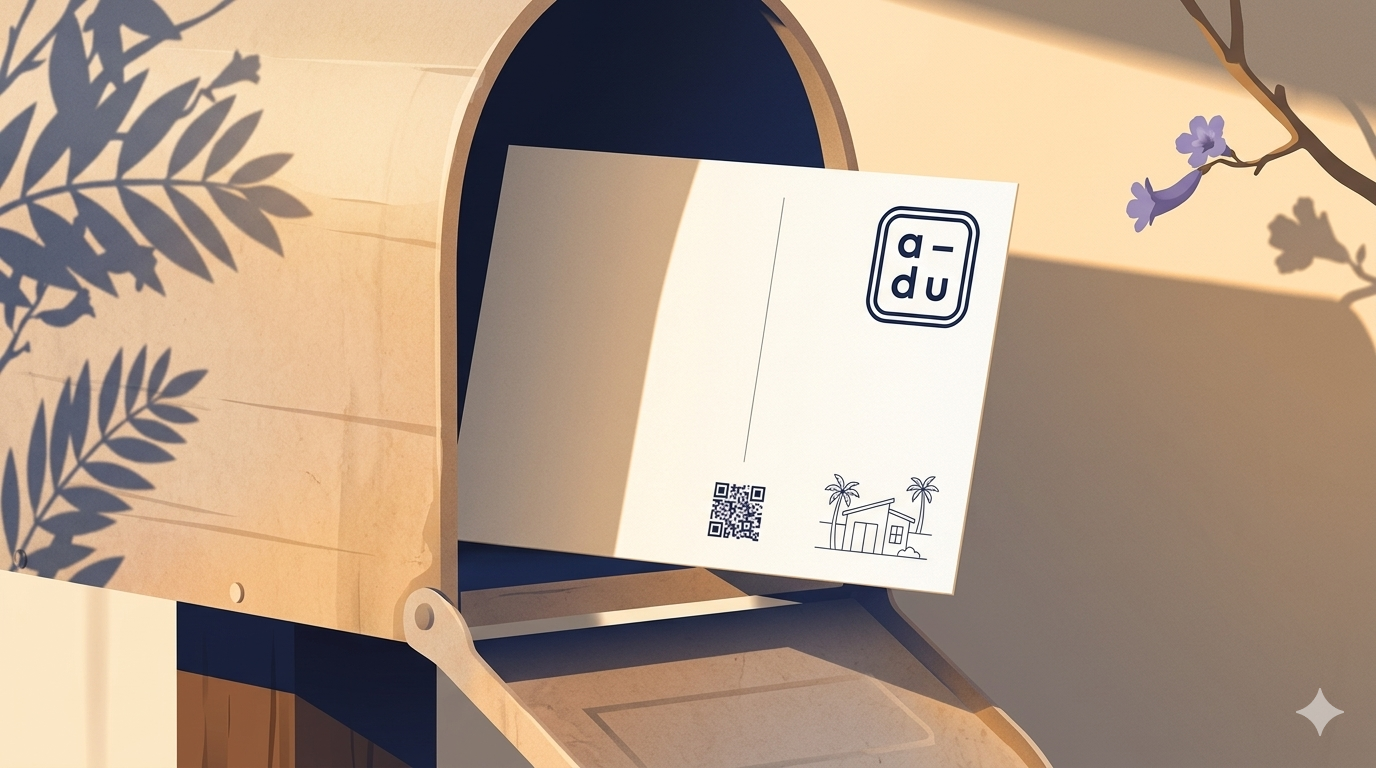
Reaching out. And this is the part that takes the brief seriously. We mail a real, physical postcard to the address on the permit. The postcard goes out through Lob, a service that turns API requests into actual pieces of mail handled by the USPS. The card is addressed to "Property Owner," doesn't claim to know anything we couldn't have learned from public record, and shows a QR code that takes the recipient to a claim page on A-du. If they scan it, they go through identity verification, prove they own the property, and become the owner of the listing on A-du. From that point forward, the listing is theirs. They can edit it, set rent, screen tenants, and run the full flow.
A few details that took real care.
Suppression. If a property owner tells us they don't want mail, we have to make sure we never send it again. We track opt-outs in a suppression list, and every time the scraper runs, it checks against that list before queuing new postcards. We even sweep already-queued mail and cancel it if an opt-out arrives between scrapes. The postcard is on a delay before it prints, and we'd rather pull it back than apologize.
Claim verification. Anyone can scan a QR code; not anyone should be able to claim a property. The claim flow walks the recipient through identity verification (the same Stripe Identity step every landlord on A-du clears) and a property-ownership check before the listing is theirs to edit. The postcard is an invitation. The verification is the actual gate.
Real estate, not surveillance. We're explicit, on the postcard and in the claim flow, that we got the address from the public permit record. We aren't pretending to know more than we do. If the property owner doesn't want to engage, the opt-out is one click on the claim page.
What it means for you
If you're an ADU owner in LA County and you've finished a build in the last few months, there's a real chance you've already seen a postcard from us. (Or you will soon.) That postcard is an offer to take over a listing we've already done the work of seeding for you, with verified identity and FCRA-aware tenant screening waiting on the other side.
For the first 100 landlords on A-du Rent, claiming and listing costs nothing. No platform fees, ever, on that listing.
If you're a tenant browsing A-du Rent, claim-pending listings are clearly labeled. You know they aren't yet active. We surface them so you can see what's out there, but the actual booking, screening, and lease flow only kicks in once an owner has claimed and activated.
What I learned
The biggest lesson here is that physical mail still works, if you're respectful about it. We send a postcard to one specific person, about one specific property, with a clearly labeled source for the data, and an unambiguous opt-out. The response we've gotten has been better than I expected, and I think it's because the postcard isn't trying to be anything other than what it is. There's no fake personalization, no manufactured urgency, no email-marketing copywriter's fingerprints all over it.
The second lesson is that respect for the source matters as much as respect for the recipient. The LA open-data portal is a public good, and abusing it would be both wrong and self-defeating. We pace our requests. We don't scrape data that's not actually published. We don't try to fingerprint across requests. The platform is better when the underlying data sources stay healthy.
The third lesson, and this is the architect's note, is that this whole pipeline only works because it sits on the rest of the platform we'd already built. The postcard wouldn't matter without identity verification on the other side, or the screening flow, or the e-signed lease, or the rent collection. The reason we can mail a stranger a postcard with confidence is that we know exactly what they'll find when they land on the claim page, and we know it's worth their time.
Next in the series: the same idea, on the other side of A-du. Surfacing pre-approved standard ADU plans from municipalities, and letting the architects who designed them claim the listing.